
Leadership & spirituality: a winning connection
27/01/2026
Every step is the goal
27/02/2026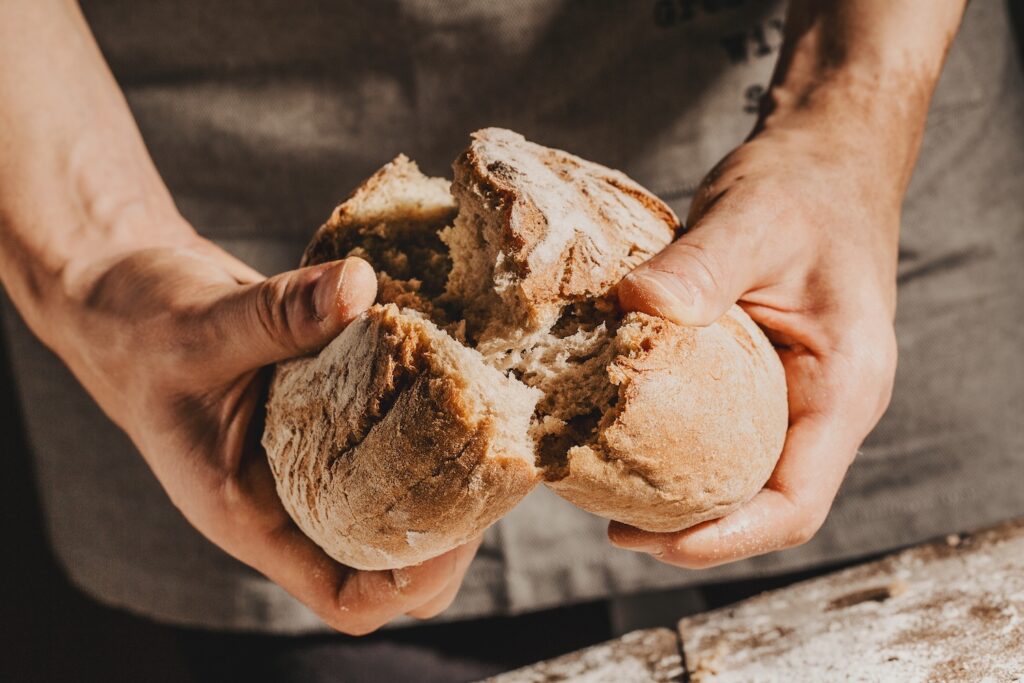
Being bread
Nurturing your team with the strength of your vision
Bread as a symbol of life and unity
Being bread. Someone very dear to me recently urged me to ‘let myself be eaten’ by those who, through me, can discover their inner light. It is a powerful suggestion that touched me deeply. It is a challenge that can be frightening; it certainly calls for great humility and requires reflection.
Offering the bread of life, breaking bread together to symbolise shared access to the sacred, is an image familiar to most Mediterranean cultures, which grew up in the shadow of wheat fields.
In ancient Roman law, the confarreatio, or breaking a spelt flatbread together, formalised the marriage union. The diffarreatio, or separating the two halves of the flatbread, represented the end of the bond, i.e. divorce. In some Middle Eastern cultures, sharing bread and salt is a seal of eternal friendship. For Christians, the legacy of the Master at the Last Supper, remembered in tradition, is bread with which we feed on Him. That’s how we renew within ourselves the presence of the Divine that He represents.
Bread, therefore, is a powerful symbol for many cultures familiar to us. It represents both the sacred in itself and equally sacred concepts and feelings, such as love and friendship. These are all essential elements of the spiritual life of human beings, without which they cannot live; at best, they survive as mere biological units.
Being bread
I am currently at a delicate and important stage in my life, at the dawn of a new great professional and personal adventure. Thus I could not receive this message without dedicating some reflection and in-depth personal research to it. Therefore I searched within myself for the essence of the message, behind and within the words. In this moment of my life I really need to hear the voice of the inner Master.
Here’s why the message I received struck my heart like a well-aimed arrow: I must accept being bread. The professional practice to which I have chosen to devote this mature phase of my career, that of coach, is aimed at people in their multidimensionality. I find myself accompanying people in all kinds of circumstances, with all kinds of problems and difficulties, seeking help to find their own solutions to the issues that trouble them.
This is where the helping profession, at this level and at this point in my journey, asks me to accept being bread. I have to let people ‘eat’ from my experience, from my knowledge accumulated over more than 60 years of curious and exploratory living. But that’s not all.
I must also try to be transparent, so that through me, the people I help can draw from the same source from which I have learned to be quench my thirst.
The humble power of service
At this point, in fact, what is required is no longer to be a professional in the common sense of the term: someone who offers a specific range of services, with certain objectives, in exchange for a fee linked to the ability to achieve the result. Now it is a question of putting oneself at the service of a broader Plan and entrusting oneself to a Direction that is no longer strictly in one’s own hands.
The Bhagavad Gita, one of the great sacred books of Hinduism, describes the path of the Karma Yogi. Such is someone who performs an action because they feel in their heart that it is the right thing to do, but is not concerned with obtaining the result. This was the way of Mahatma (meaning Great Soul) Gandhi, who was a devoted follower of the teachings of the Bhagavad Gita (meaning The Song of the Divine).
Now it is a matter of reaping the fruits of decades of life and experience, kneading them with the sweat of practice and tears shed, letting them rise with patient trust and baking them in the fire of love. At that point, the resulting bread can be broken with those who are hungry. What those who eat it will do with it and what results will follow is unknown. The baker does not know what will become of his bread, but every night he bakes it with love and trust that it will be good and serve a noble purpose that completely escapes him.
First step: let go of fear
I confess that, in putting down on paper the reflections that have emerged from this work of deep inner investigation, I feel a little fear making my hands tremble.
My greatest fear is letting go of control, after a lifetime of being taught to achieve ever greater control. The second fear, close behind the first, is that I might have fallen into an insidious trap set by my ego. Given the ‘sacred’ precedents of sharing bread, these are weighty words.
But if the director I trust is truly the Director, then everything will turn out for the best. I will not be the one to seek out hungry people, nor to decide how they should eat. Once I have decided to make available everything that I have accumulated, structured and “baked” along my life’s journey, it will be available in recipes that are suitable for nourishing the person in the most appropriate way. The only thing that will really matter is how firm and deep my vision and faith in it are.
The result for the person who feeds on it will be their return to themselves, through ways and means that are not for me to decide.
Why leaders must be bread
At this point, enough about me and what the revelation following that precious gift from my loved one meant to me. It may not be very interesting to readers of this blog. Let’s look instead at why this topic is important for any leader.
In fact, for many years I have been involved in leadership and issues related to the responsibility of those who influence the lives of others. I have assisted entrepreneurs, executives, doctors and therapists, politicians, organisations and institutions. But I have also been responsible for directly helping people in individual coaching sessions and programmes. For years, I have sought the essence of all these roles, regardless of who held them. Now it is clear to me.
Being bread, being nourishment for the vitality and growth of the people for whom you are responsible, seems to me to be the true essence of leadership. It does not matter whether you are the CEO of a multinational corporation or a father or mother of a family. When Life gives you responsibility for (and power over) other people, it is asking you to be bread.
Nurturing the thousands upon thousands of lights
The skill of a leader, or of someone in a helping profession such as a coach or doctor, consists in offering themselves so that the people for whom they accept responsibility can discover and express their special sparkle. Everyone has their own light and everyone should be helped to express the best of themselves, not to replicate the leader’s light frequency. Nor, in the case of coaches or doctors, should they become like them or adopt their concept of health.
Excellent leadership is that which supports people in discovering who they are, in their truest essence, and in expressing it. An excellent therapist is one who makes all their knowledge and experience available to the suffering person to help them find their own path to health or an acceptable state of well-being.
An excellent leader or ‘helper’ has no selfish expectations of people and does not want to create clones of themselves. They would be flawed clones anyway, because each of us is a unique and unrepeatable being. Furthermore, because they respect the people for whom they are responsible, they consider them to be beings with dignity and a right to be themselves. An organisation led by a true leader shines with a thousand different lights, none of which are the same as that of the leader.
Nurturing with a strong vision
If leaders – here I am equating other roles with that of leader, to simplify matters – should not create clones of themselves, what about their vision? How can I involve other people in collaborating to realise my vision?
The answer can be found in anthropological knowledge of humankind. We are social beings, driven by an innate desire to improve the condition of our community. This dates back to the dawn of time, when we lived in small tribes of hunter-gatherers. This way of being and living lasted so long – at least 200,000 years – that it became ingrained in our deepest heritage.
Therefore, anyone who wants to be an excellent leader must have such a strong vision that their project will be beneficial to everyone, inspiring people to contribute their best. In other roles, such as that of a therapist, their conviction will be so strong and deep-rooted, and their spirit of service so humble and powerful, that they will inspire and motivate their patients even beyond the expected direct effects (for example, with a placebo effect).
In other words, the gift of a leader who inspires people is their faith in their own vision or beliefs. At that point, like the Karma Yogi, they can let the vision they offer to others awaken their own selves, allowing them to offer the best of themselves in turn.
Wish to discover what your bread tastes like?
Each of us, at our own level and in our own field, has the opportunity to be bread. There are no limits to what we can offer our neighbours and the common good. Every recipe is beneficial, as long as it is made with love: loaves, rolls, breadsticks, rosettes… there are more than eight billion ‘types of bread’ on Earth.
To discover yours, write to me at federico@federicofioretto.biz to arrange a free introductory meeting; together we will find out if and how I can help you.
If you liked this article, you may also be interested in a recent article on Leadership and Spirituality.
