

Being bread
26/02/2026
When the family business feels like a prison
18/03/2026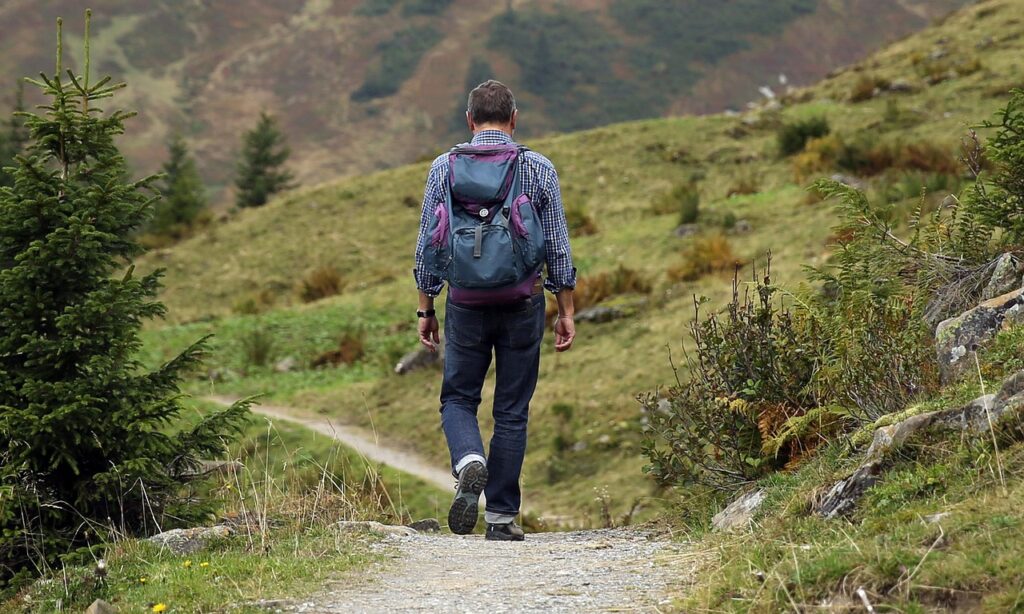
Every step is the goal
Why focusing solely on the final goal is a mistake
The noisy wood
A few days ago, as is my passion, I was walking alone in the mountains. I had just set off on the path which, after a challenging climb of about 700 metres, would take me along a beautiful ridge.
After walking for a short while, I noticed a group of people ahead of me, apparently young people, who were very talkative. For the moment, I could glimpse them from time to time, when the winding path allowed it. They appeared and disappeared among the silhouettes of the bare trees, but the noise of their incessant chatter overwhelmed the silence without pause.
For me, who seeks silence and inspiration, communion and nourishment for the soul in Nature, this was becoming a nuisance. I considered whether I could change of trek, but there were not many alternatives in that area. I would have had to turn back, get back in the car and drive quite a distance to find a trek with the same promise. It did not seem worth it.
We seemed to be walking at roughly the same pace, perhaps I was a little faster. I could hope that their inexperience would allow me to overtake them and distance myself when the path became more challenging. So I sped up.
The overtaking
I caught up with them quite easily. They were boys and girls in their late teens, perhaps twenties, several of whom had unsuitable footwear and generally poor equipment. Nevertheless, they proceeded cheerfully, with the strength of their age, talking incessantly among themselves about this and that.
The driving test, this or that school friend, the parish priest who is also a mountain lover… they carried on with their jokes and banter. I caught up with them, riding their wave of sound, concentrating on my accelerated pace to overtake them and distance myself from them as soon as possible. One, two, one two, inhale, two steps, exhale, two steps, inhale…
Thanks to my steady pace, I was soon ready to overtake them. My arrival was announced by the rear guard and they kindly stepped aside to let me pass. I greeted them, thanked them and continued on my way, still going quite fast, even though the path was getting steeper and steeper. My hope was to leave behind the cloud of sound they were emitting and find my silence again. For a while, I savoured the illusion.
The bitter discovery of unexpected acoustics
After a brief interval during which I felt a certain relief at realising that I was walking in the silence of the woods, the path began to climb steeply. I needed my hands to cling to plants, shrubs and rocks in order to climb.
The mountain became steep and its towering wall in front of us played a cruel joke on me: as my progress slowed down, a game of echoes brought forward the voices of the youngsters I had left behind a while ago. The sound of chatter returned forcefully to occupy my auditory sphere.
I realised that I was intensifying my efforts to climb, trying to get away from the annoying noise. Alas, without much success. The acoustics of the place were unfavourable to me. There was no way to escape those sounds and find the peace of the forest again.
Moreover, I was the first to ‘lose my peace’: I was more focused on trying to shake off the pursuit than I was on the beauty of the surroundings and the gentle communication of Nature. What to do, then?
Every step, centre yourself
If the goal I was seeking on that path was to nourish peace through interaction and communication with Nature, I definitely had to escape from that stress of running away. I turned my thoughts away from my obsessive focus on the noise of voices and turned them inward.
What was happening inside me? What were my biological rhythms like? I realised I was slightly out of breath. I was keeping a pace that was too fast for the slope and… for my legs, which were almost two generations older than those of the people I was trying to distance. I came to my senses and decided to come to my senses.
I checked the map and the altitude. Soon I would reach a turning point on the edge of the mountain that would take me to the sunny side and out of the woods, which were already becoming increasingly thin. From what I could see of the mountain’s morphology, we should have more favourable acoustic conditions on the other side. We would be in a more open field. Above all, I decided that I would once again focus my mind and every effort on my goals. Not on escaping those of others.
Let it be
I slowed down just enough to get back to an acceptable walking-breathing pace. Now the goal was to reach the corner and, if I found the terrain as I imagined it from the map, take a break there. I would let the boys and girls pass, asking them what route they were taking. The idea was to give them a big head start so that I could once again adjust my pace according to my inner feelings. As if I were alone on the mountain, with no more interference or distractions in my dialogue with Nature.
At the edge, I was rewarded. As I turned out into the sun, I noticed that the forest ended right at that change in slope. In front of me, to the north, a magnificent view of the snow-capped Alps opened up, beyond the mist-covered Po Valley. A square boulder provided a comfortable seat from which to contemplate such beauty. For a moment, there was even a lull in the chatter coming from behind, as the sound wave was dispersed by the open space.
I took the thermos with tea and a banana out of my rucksack, preparing myself for a comfortable and blissful break in front of such beauty. I was ready to let go of the frenzy that had taken hold of me and get back to myself again. But I was also ready to focus on the lesson underlying such experience.
Sipping and listening
As I sipped the hot drink, I listened to my feelings towards the chattering youngsters, constantly stimulated by their voices that were inexorably drawing closer.
At first, I felt a lingering irritation, looking at my weakness first with regret, then with compassion so that it could dissipate. Yes, my first reaction to their chatter was annoyance, irritation. How dare they disturb the peace of my walk? Fortunately, I am used to looking within myself for the source of my reactions!
I realised that what irritated me was the fact that for those young people, at least as I interpreted it, reaching the mountain top ‘was the goal’. That is, until they reached the summit designated as their destination, they would chat about this and that as if they were at a bar or during a break at school. The context, the lush and conversational nature around them, the interaction with it, were not relevant. They did not matter.
If there had been a cable car to take them to the top, they would have taken it without hesitation. Everything between the car parked at the base and the top of the mountain was as if invisible. Their steps on the path were mechanical. A teleport would have replaced them without any sense of loss. This was my interpretation of their behaviour and what had irritated me.
Every step is the goal
I acknowledged how much of that irritation was mine and set out to find the lesson it held for me. What could I take home from that encounter, which was certainly not accidental?
What did I want to convey to those young people, which was ultimately the lesson that Life was offering me that morning on Monte Gonio? I searched within myself and found the loving kindness with which to dialogue with my pursuers, who were inexorably closing in on me.
What I wanted to share, and therefore learn and deeply internalise myself, was that every step is the goal. The final destination, in this case a mountain peak or ridge, is only the pretext that sets us in motion. But every step is the true goal of the hike.
The real goal of every movement we make, of our very lives, is to walk in the present, aware of our surroundings and our actions. It happens when you move gracefully, adding beauty to the world with every step, respecting the path, the flowers and the bushes we brush aside as we advance. Or when you leave just a light trail that helps those who follow, without making the path uncomfortable with footprints that are too deep. It is perhaps discovering a new path that leads to an unknown corner, even if it is insignificant for the fate of the world. It happens when you deviate from the path, even abandoning it, to reach out to a fellow human being in difficulty, to comfort them and, if necessary, accompany them downhill, taking care of them.
The end of failure
Life had recently taught me that I had to ‘be bread‘ in order to nourish the people I take responsibility for as a coach and therapist; today it taught me how to walk. More precisely, it taught me why I walk in a certain way in the mountains. Through this teaching, it taught me how to live, how to go through the experience in this body and in this time: walking every step as a goal.
In our culture, we learn to constantly pursue goals, achieve results, perform well and seek success. We live in constant competition with ourselves and others. This translates into an enormous amount of stress, with all the effects that come with it.
This attitude also means that when we do not achieve our goal, we feel a sense of failure. The fear of failure, or the shame of it, is one of the most widespread forms of (self-inflicted) violence of our time.
If the way I walk towards my goal becomes more important than achieving it, once I have walked to the best of my ability, the possibility of failure no longer exists. ‘How I walk’ is totally under my control. Achieving the goal, as various sacred texts teach, is not.
Dancing throughout life
When every step is the goal, we live in the present moment; then we learn to dance through life, moving with grace and lightness. Stress diminishes and we focus on small steps, not on distant destinations, great distances, missions that intimidate and bewilder us.
I may also pursue the ideal aspiration to change the world, but if I focus on taking each step with grace as my priority goal, then my daily tasks become greatly simplified.
I will pay attention to how I wake up in the morning. Is gratitude my first thought? If not, why? Then I can look for causes close to me, which pertain to my daily life. What can I change in my life so that I can wake up every day with gratitude?
Does a big smile come naturally when I meet my colleagues at work? Am I happy to see them again today? Do I feel joy in what I do as a profession? Do I feel that I am doing something useful? Have I brought serenity to someone I met in a moment of difficulty?
Do I spend happy moments with my children as I watch them grow and hold their hands as they explore life? Or do I feel that when I am with them, my mind is clouded with stress, which I unload on them with my bad mood? So how can I make this daily ‘step’ lighter and more joyful? And so on.
Ask kindly
When every step is the goal, kindness automatically kicks in. Yes, because when I am focused on making every step a work of art, the desire to do so with grace arises spontaneously.
Immersed in these thoughts, I waited in a cheerful mood for the young people who were following me; in a few minutes, they appeared one after the other from around the corner. Now I could see them better: there were about ten boys and girls, I would say between eighteen and twenty years old. They were beautiful, with clean-cut, smiling faces despite the rigour of the climb they had just completed. Blessed energy of youth!
I greeted them and demanded if I could ask them two questions. When they said yes, I first checked their itinerary. They told me that the last one in line knew it; he confirmed that it would be about half the same as mine.
Then I asked the crucial question: I asked them if they ever felt the need for a moment of silence while walking in nature. For a moment, they were taken aback by the question. I reassured them that it was not a reproach; I must have seemed very old to them, like a gruff professor. But I managed to make them laugh and relax.
They replied that they did so when they stopped out of breath. Exploring whether they felt any communication, any message from the natural environment as they walked immersed in it, I had confirmation that no, they had no communication with their surroundings. On a conscious level, I understood, of course. Feeling a little sorry for them, but aware of the reality, I told them I would let them go ahead, and we exchanged cordial greetings and wishes for a good day.
Recovering the lost steps
We are too caught up in the thousand goals that are set before us in the course of a lifetime, consumed by our failure to achieve many of them. At the same time, we lose sight of millions that we could easily achieve and that would fill us with joy and satisfaction.
If every step is the goal, we focus on every moment in the present and use our full power to dance throughout it with grace and love. This is totally within our power. This allows us to recover the many lost steps.
We know from experience or from news reports that many people are willing to take ‘shortcuts’ in order to achieve certain goals. Sometimes these routes pass through dark paths: they become harmful to other people or to the common good. However, they appear acceptable when all that matters is reaching the final goal. It is as if, in order to reach the summit of the mountain we aspire to, we were willing to greatly damage it to build a comfortable rack railway that would take us up there without any effort.
But when every step is the goal to be achieved, and the goal is only the reason to set in motion, then the means become more important than the ends. As Gandhi said, such are the means, such is the end that is achieved.
Moving gracefully with every step, I will reach Grace, this is my conclusion. I think it’s worth it.
Find your own walking style
If you need help finding your ideal style to make every step a masterpiece, write to me at federico@federicofioretto.biz to book a free initial consultation and see if and how I can help you.
